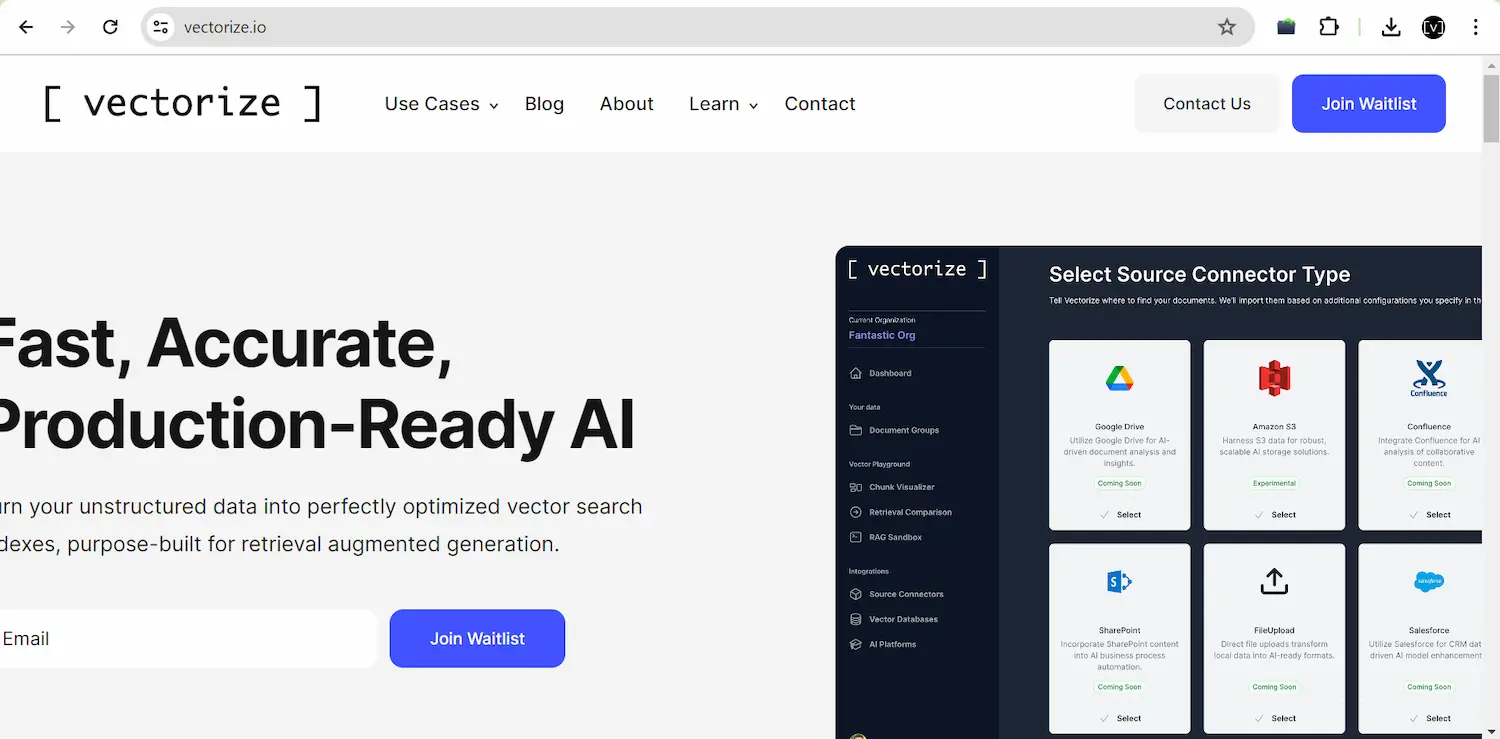
Fast, Accurate, Production-Ready RAG Pipelines Turn your unstructured data into perfectly optimized vector search indexes, purpose-built for retrieval augmented generation.
Vectorize official website
If you’ve ever built an LLM-powered application using retrieval-augmented generation (RAG), you’ve probably encountered many of these common challenges:
You launch your application only to face user complaints that the LLM is hallucinating.
The LLM struggles to answer basic questions it should have no problems answering.
You spend days writing scripts to compare inference results using different chunking strategies and embedding models in your vector database
You struggle to quantify exactly which vectorization strategy works best on your data.
You try using the highest-performing embedding models on the Hugging Face leaderboard, but they just don’t seem to work that well on your data.
If you’ve faced these problems, you’re in good company. The founders of Vectorize spent the better part of 2023 working closely with developers to build and launch dozens of RAG applications at companies large and small. Every single team ran into some combination of these problems. Vectorize is the platform we kept wishing we had to help these teams get their LLM-powered applications into production with the confidence that they would always have the most accurate, relevant context to help the LLM perform at its best.
Today, we are excited to announce that Vectorize is publicly available for anyone to try for free! If you are building LLM-powered RAG applications or think you will need to in the future, we believe that once you try Vectorize, you’ll never want to build another RAG application without it.
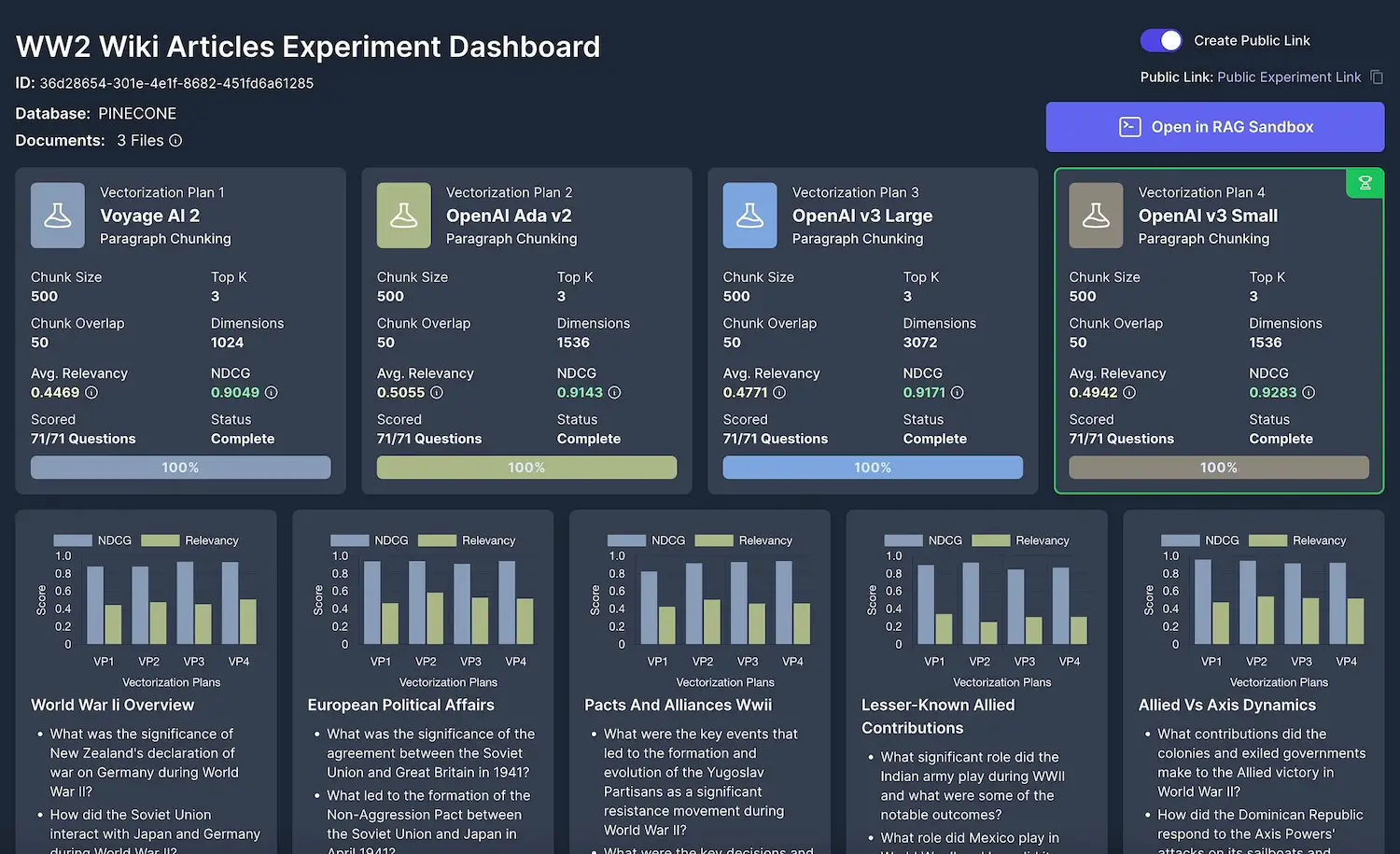
This release focuses on a feature we call Experiments. This feature allows you to experiment with different embedding models, chunking strategies, and retrieval configurations to find the combination that will work best with your data. With Experiments, you can determine the best methods for creating highly relevant search indexes for your Retrieval Augmented Generation (RAG) applications. This data-driven approach eliminates guesswork and replaces it with precise, data-driven evaluations, helping you build the most effective generative AI solutions.
While it’s great to have concrete data to help you understand which vectorization strategy works best for your data, it’s still wise to compare those results against your own personal assessment. To facilitate this comparison, we have introduced the RAG Sandbox.
Leveraging the vector search indexes generated in your experiments, the RAG sandbox gives you the ability to test end-to-end RAG scenarios. Here you can submit a prompt to one of the many supported LLMs, such as Llama 3, Gemma, Mixtral, and others, that are powered by Groq, along with GPT-3.5 from OpenAI. (See the RAG Sandbox in action; no registration required. ↗)
The RAG Sandbox gives you complete visibility into the retrieval-augmented generation process. You can inspect the context that comes back from the vector database and see relevancy scores, normalized discounted cumulative gain (NDCG) scores, and cosine similarity. You can then adjust your prompt, LLM, and LLM settings to see how these tweaks impact the overall effectiveness of your RAG setup.
Features and Benefits of Vectorize
Unleash the power of Large Language Models on your data in 3 easy steps
Import data from anywhere in your organization
Open Interpreter is an open-source terminal agent, forked from Codex, that reads and edits files and runs commands inside an OS-level sandbox with approvals. It is free under Apache 2.0 and works with local models through Ollama or LM Studio.
Together AI is a cloud platform for running open models through a per-token serverless API, plus dedicated endpoints, GPU clusters and fine-tuning. Hosted GLM-5.3-Flash, for example, is listed at $0.15 input and $0.50 output per million tokens.
Kimi is Moonshot AI's assistant and model family, offered as the kimi.com agent workspace and as a pay-as-you-go API. The Kimi K2.7 Code model is listed at $0.95 input and $4.00 output per million tokens.
Z.ai offers the GLM model family through a chat app and a developer API billed per million tokens. GLM-5.3-Flash is listed at $0.15 input and $0.50 output, and the API is compatible with the OpenAI SDK.
The Gemini API and Google AI Studio let developers build with Google's Gemini models for text, code, images, video and speech. A free tier covers some models; paid use is billed per million tokens, such as $0.30 in and $2.50 out on Gemini 3.5 Flash-Lite.
The Claude API is Anthropic's developer platform for building apps and agents on Claude models, billed per million tokens. Rates run from Claude Haiku 5.5 at $0.10 input and $0.50 output up to Claude Fable 5.1 at $10 and $50.